1/31/2026 - How We Finance Our Fear
Modern slavery doesn’t always arrive with chains. Sometimes it arrives as a minimum payment.
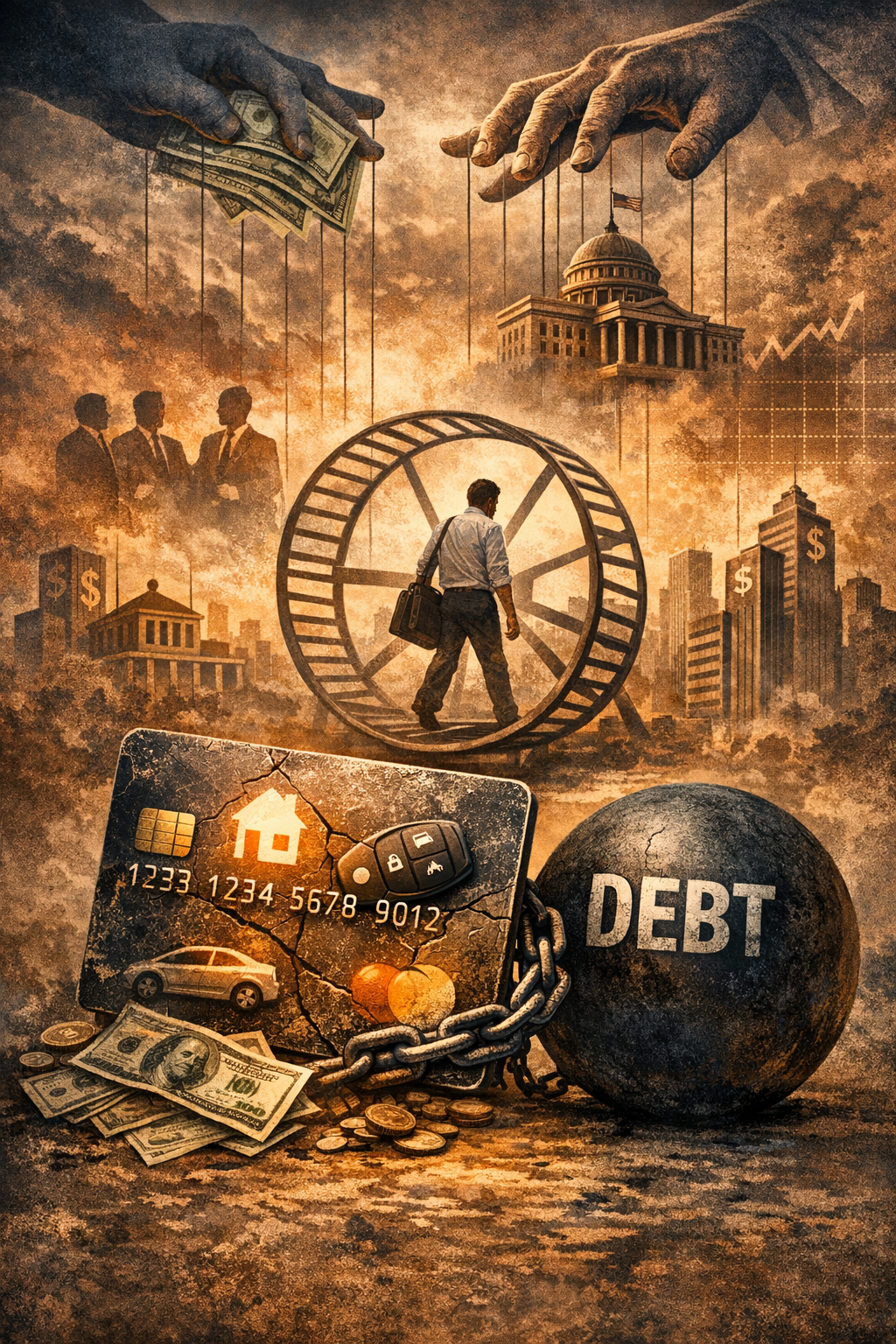
In Crushing Wheels: Manmade Chains / Existence in the Age of Systems, I keep circling one uncomfortable truth: a system doesn’t need to imprison your body if it can capture your attention, shape your desires, and monetize your anxiety. Debt is the quiet mechanism. A mortgage on an overpriced home because “that’s what adults do.” A new car note every few years because driving the old one feels like falling behind. A credit-card balance because consumption becomes a sedative—an easy way to quiet the deeper question: Am I safe? Am I enough? Do I matter? When the soothing fades, the bill stays. Then interest starts talking.
And this wheel isn’t small—it’s industrial scale. Total U.S. household debt hit $18.59 trillion in Q3 2025. Credit card balances alone reached $1.23 trillion. The price tag of revolving debt is brutal: the assessed commercial-bank credit card interest rate was 22.30% in November 2025. In Consumer Financial Protection Bureau reporting on 2024 outcomes, consumers were assessed $160B in credit card interest charges (up from $105B in 2022), and average APRs reached 25.2% for general-purpose cards—levels they note are the highest since at least 2015. This isn’t “bad budgeting” as a moral flaw. It’s a treadmill with a business model.
Now let’s talk about the part people hate hearing: “financial literacy.” Yes, it matters. But the bigger point is where the system is weak by design: education is uneven, late, and often optional. FINRA Foundation found that 53% say they always pay their credit cards in full—meaning nearly half don’t. And 59% of cardholders engage in at least one behaviour that triggers interest or fees (41% do two or more). Meanwhile, requirements are improving—but it’s still patchwork. Council for Economic Education reported 35 states now require a personal finance course for graduation. Progress, yes. But also, proof that for decades this wasn’t treated like essential literacy—more like an elective you “should’ve figured out.”
And retail banking doesn’t just “offer products.” It profits from financial friction—especially when people are stressed, cash-flow negative, or living paycheck-to-paycheck. Overdraft and NSF fees are the clearest example: $5.83B in reported overdraft/NSF fee revenue in 2023. Add penalty pricing, late fees, and high APRs, and the pattern is simple: small mistakes get priced like crimes. The most expensive money is sold to the people who can least afford it. Not because bankers are cartoon villains—because incentives reward extracting margin from fragility.
Then comes the political layer. When you connect consumer debt, lobbying, and the stability goals of financial institutions, it becomes harder to believe the average person is steering the ship. Larry Bartels documented “differential responsiveness”—that United States Senate is more responsive to affluent constituents than to middle- and lower-income constituents. And Martin Gilens and Benjamin Page found that economic elites and business-oriented organized interests have substantial independent influence on U.S. policy outcomes, while average citizens have little or no independent influence. Voting still matters. But it can coexist with a lived reality where many people feel their vote barely touches the economic rules that shape their lives.
It’s tempting to say “governments keep people financially ignorant on purpose.” Sometimes that’s true in spirit, but it’s usually messier than intention. The wheel is powered by many hands: housing shortages and zoning constraints, employer-driven geographic clustering, marketing algorithms, status competition, and a financial system that charges more when you’re already down. The trap doesn’t need a mastermind. It just needs aligned incentives.
The result looks like this: people running hard just to afford a small place in a big city. Buying things they don’t need. Wearing brands that add no function. Financing identity because identity feels shaky. And using consumption as anaesthesia—because facing the deeper discomfort is harder than clicking “Buy Now.”
The deeper tragedy isn’t debt itself. It’s the trade: we borrow against our future to purchase temporary relief from existential fear—then we call it “normal life.”
1/16/2026 - About Freedom
What is freedom?
Many people confuse freedom with freedom of choice. And to be clear, freedom of choice matters. The ability to choose your clothes, friends, community, beliefs, and the direction of your life is not a small thing. People risk everything for it.
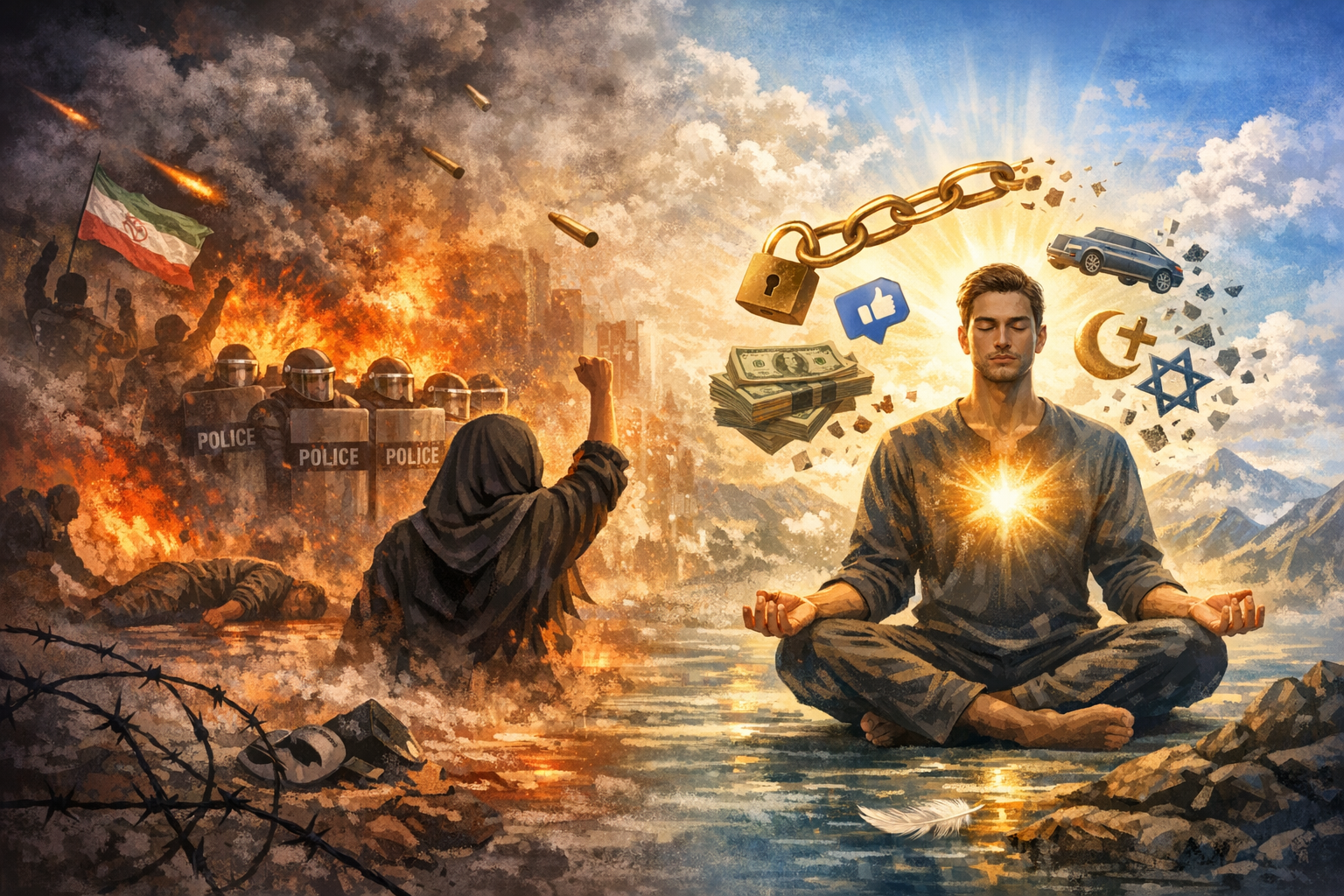
Look at Iran. People have stood in front of bullets, and thousands have died, trying to reclaim the right to live without fear.
But freedom of choice, as vital as it is, is still external. It depends on laws, institutions, and whoever holds power. That means it can be restricted, manipulated, or taken away.
True freedom is internal. It’s the kind of freedom that remains even when circumstances are harsh: the ability to stay grounded, to choose your response, and to live without being owned by what’s outside you.
You are free when your identity is not chained to external things: status, approval, possessions, ideology, or group belonging. You can use these things. You can enjoy them. You can even fight for them. But you don’t let them define you.
External freedom protects life.
Internal freedom protects the self.
The most fragile form of freedom is the one that depends on the world behaving nicely.
The strongest form of freedom is the one that survives when it doesn’t.1/About Freedom
What is freedom?
Many people confuse freedom with freedom of choice. And to be clear, freedom of choice matters. The ability to choose your clothes, friends, community, beliefs, and the direction of your life is not a small thing. People risk everything for it.
Look at Iran. People have stood in front of bullets, and thousands have died, trying to reclaim the right to live without fear.
But freedom of choice, as vital as it is, is still external. It depends on laws, institutions, and whoever holds power. That means it can be restricted, manipulated, or taken away.
True freedom is internal. It’s the kind of freedom that remains even when circumstances are harsh: the ability to stay grounded, to choose your response, and to live without being owned by what’s outside you.
You are free when your identity is not chained to external things: status, approval, possessions, ideology, or group belonging. You can use these things. You can enjoy them. You can even fight for them. But you don’t let them define you.
External freedom protects life.
Internal freedom protects the self.
The most fragile form of freedom is the one that depends on the world behaving nicely.
The strongest form of freedom is the one that survives when it doesn’t.About Freedom
What is freedom?
Many people confuse freedom with freedom of choice. And to be clear, freedom of choice matters. The ability to choose your clothes, friends, community, beliefs, and the direction of your life is not a small thing. People risk everything for it.
Look at Iran. People have stood in front of bullets, and thousands have died, trying to reclaim the right to live without fear.
But freedom of choice, as vital as it is, is still external. It depends on laws, institutions, and whoever holds power. That means it can be restricted, manipulated, or taken away.
True freedom is internal. It’s the kind of freedom that remains even when circumstances are harsh: the ability to stay grounded, to choose your response, and to live without being owned by what’s outside you.
You are free when your identity is not chained to external things: status, approval, possessions, ideology, or group belonging. You can use these things. You can enjoy them. You can even fight for them. But you don’t let them define you.
External freedom protects life.
Internal freedom protects the self.
The most fragile form of freedom is the one that depends on the world behaving nicely.
The strongest form of freedom is the one that survives when it doesn’t.About Freedom
What is freedom?
Many people confuse freedom with freedom of choice. And to be clear, freedom of choice matters. The ability to choose your clothes, friends, community, beliefs, and the direction of your life is not a small thing. People risk everything for it.
Look at Iran. People have stood in front of bullets, and thousands have died, trying to reclaim the right to live without fear.
But freedom of choice, as vital as it is, is still external. It depends on laws, institutions, and whoever holds power. That means it can be restricted, manipulated, or taken away.
True freedom is internal. It’s the kind of freedom that remains even when circumstances are harsh: the ability to stay grounded, to choose your response, and to live without being owned by what’s outside you.
You are free when your identity is not chained to external things: status, approval, possessions, ideology, or group belonging. You can use these things. You can enjoy them. You can even fight for them. But you don’t let them define you.
External freedom protects life.
Internal freedom protects the self.
The most fragile form of freedom is the one that depends on the world behaving nicely.
The strongest form of freedom is the one that survives when it doesn’t.
1/11/2026— The First Gear
Most of us don’t feel “oppressed.” We feel something quieter: a constant pressure to keep up—money, status, productivity, even happiness.
That’s the core of Crushing Wheels: Manmade Chains: not a single villain, but systems that keep turning because we keep feeding them—often out of fear.
Here’s the starting question:
What is a chain if no one is holding it?
Modern chains aren’t usually physical. Their beliefs that sit in the nervous system:
“If I slow down, I’ll fall behind.”
“Rest is laziness.”
“My worth must be visible.”
“If I don’t prove myself, I’ll be forgotten.”
A chain doesn’t need a master. It only needs a belief that feels “obvious.”
One exercise for this week (7 days)
Once a day, write two lines:
The wheel I fed today was…
The chain I felt today was…
Example:
“The wheel I fed today was looking competent.”
“The chain I felt today was fear of disappointment.”
Clarity is the first crack in the chain.
Question for you
What’s one belief you live by that you didn’t consciously choose—and what does it cost you?